|
---------------------------- 2023 Platform Presentation Winner --------------------------
Molecular Landscape and Clinical Behavior of
Stage I p53-Abnormal Low-Grade Endometrioid
Endometrial Carcinomas
Lisa Vermij, Amy Jamieson, Joseph Carlson,
Brooke Howitt, Philip Ip, Sigurd Lax, Glenn
McCluggage, Naveena Singh, Remi Nout, Carien Creutzberg, Nanda Horeweg, Tjalling Bosse, C. Blake Gilks
Background: The clinical significance of applying the TCGA molecular
classification in stage I low-grade endometrial endometrioid
carcinoma (EEC) is under debate as these patients generally
have an excellent clinical outcome. However, a small subset of
stage I low-grade EEC are p53-abnormal (p53abn) and may
have a poor prognosis, although their existence is questioned.
Here, we aimed to pathologically review and characterize stage
I low-grade p53abn EEC previously identified in our databases.
Design: Tumor material from the PORTEC-1 and -2 trials (n=881) and
retrospectively collected Canadian historic cohorts (n=2506)
was available for analysis. All patients with previously reported
stage I p53abn EEC were selected; none of these exhibited
pathogenic POLE mutations or mismatch repair-deficiency.
Abnormal p53 status was confirmed by p53
Tue,
March 14
9:00
AM - 9:15
AM
CC
Room 217
immunohistochemistry (IHC) and TP53 mutation analysis.
Review of histotype and FIGO grading was performed by six
expert gynecological pathologists, blinded to the molecular
subgroup and study aim, using one H&E-stained section per
case. Low-grade NSMP EEC (n=10) and p53abn serous
carcinomas (n=13) were included as controls. The mutational
landscape was assessed with next generation sequencing. The
Kaplan-Meier method was used for the assessment of
recurrence-free survival (RFS).
Results: In total, 55 p53abn stage I low-grade EEC were identified.
Following pathology review, 17 (30.9%) cases were assigned
as not low-grade EEC by all of the expert pathologists, while 38
(69.1%) and 26 (47.3%) were assigned low-grade EEC by ≥1
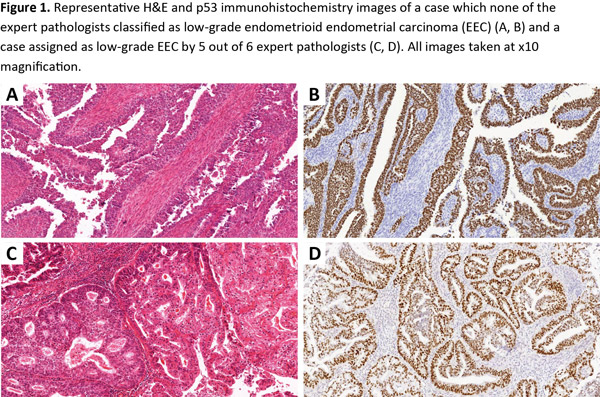
and ≥3 pathologists, respectively. Two representative cases are
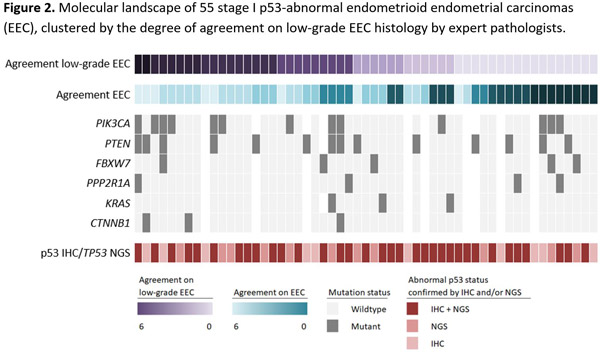
illustrated in figure 1. Clustering cases by agreement on lowgrade
EEC histology showed no significant differences in
mutational landscape, with a low prevalence of PTEN and
PIK3CA mutations in all cases (figure 2). 5-year RFS was higher
with increasing agreement on low-grade EEC histology, with a
5-year RFS of 61.9%, 72.8% and 76.5% for cases assigned as
low-grade EEC by none, ≥1 and ≥3 pathologists, respectively.
Conclusions: A subset of p53abn endometrial carcinomas are
morphologically low-grade endometrioid with a molecular
landscape that is similar to prototypical p53abn endometrial
carcinomas. The risk of recurrence for patients with stage I
low-grade p53abn EEC is higher compared to the risk of
recurrence of stage I low-grade EEC in literature. Our results
may support performing molecular classification on all
endometrial carcinomas.
|